From repository to production, engineered.
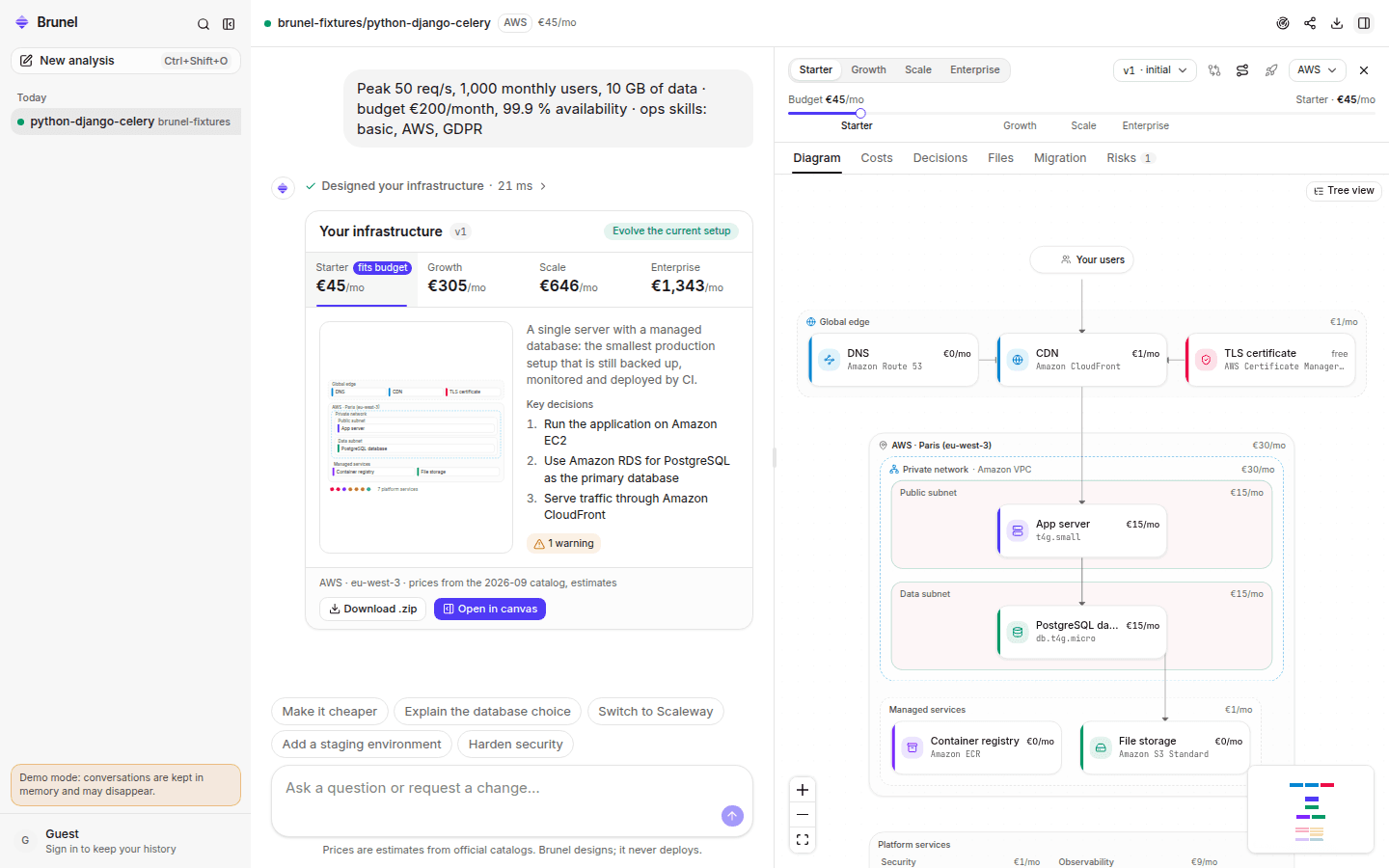
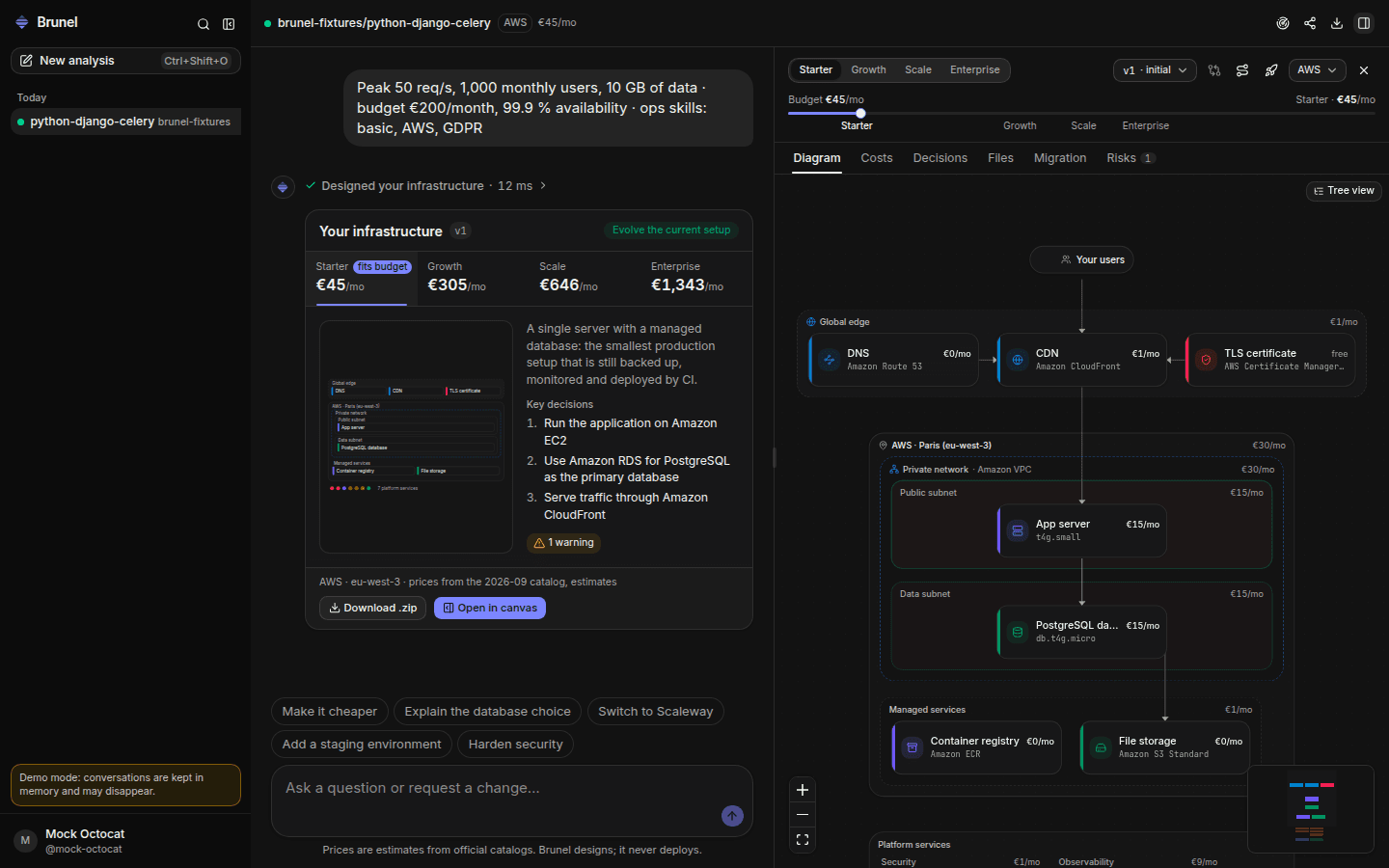
Brunel reads your code and designs the infrastructure it needs: four architectures priced from official cloud catalogs, explained component by component, delivered as validated Terraform.
Invitation only for now · sign in with an invited GitHub account
- TypeScript
- Python
- Go
- Java
- Kotlin
- PHP
- Ruby
- Rust
The problem
Your app works on your laptop. What should production look like?
Most teams guess. Advice is generic, the bill arrives after the launch, and backups, monitoring and secrets are left for later. A senior cloud architect is the answer, and most teams do not have one.
Generic advice
“Use Kubernetes.” For a single API and a queue? Brunel starts from what the code actually does.
Surprise bills
Every component is priced before you build it, with the catalog date and the assumptions shown.
Missing pieces
Backups, monitoring, secrets, CI and environments are part of every design, never an afterthought.
No explanation
Each choice comes with its reason, its cost and the alternatives that were rejected.
How it works
Four steps, one conversation
Everything happens in a chat next to a live architecture canvas.
- 1
Analyze
Brunel reads the repository, never runs it, and lists what it needs, with the file and line as proof.
- 2
Design
Four architectures from €20 to €20,000 a month, each priced from AWS and Scaleway catalogs.
- 3
Refine
Ask for changes in plain words. Every change is a version you can compare and roll back.
- 4
Ship
Download the files, or let Brunel open a pull request that runs in your own CI.
The product
See every step
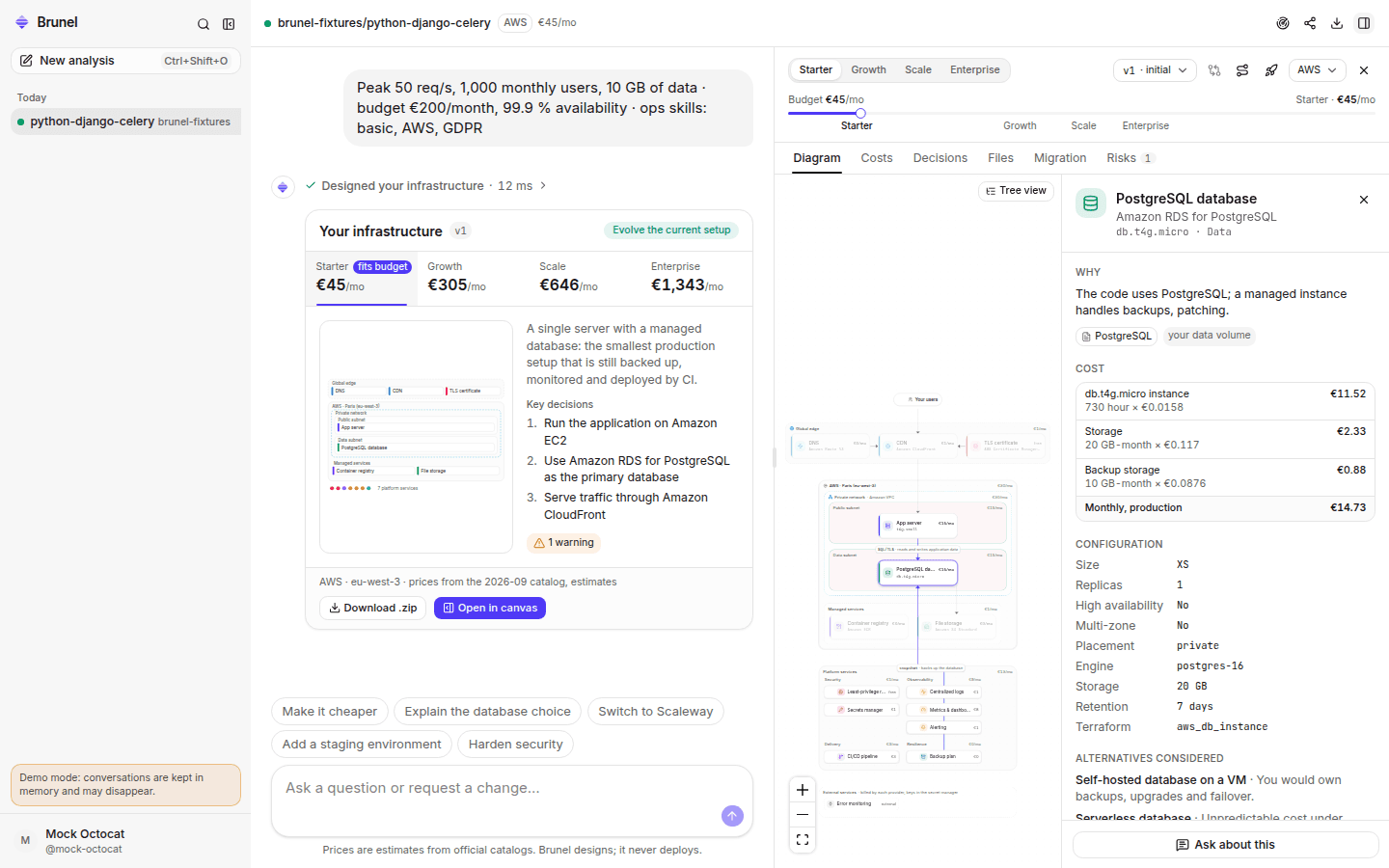
Why it is there, what it costs
Click any component: the reason, the cost breakdown, the configuration and the alternatives that were considered.
Beyond the design
Everything a cloud architect would do, and keeps doing
Brunel does not stop at a diagram: it checks security, plans migrations, watches every push and ships through your own CI.
Facts, not guesses
Prices you can check
Security check
Migration plans
Live tracking
Pull request reviews
Validated files
Built for agents
Measured, not claimed
Tested on real repositories
Every release runs the full pipeline on 15 open-source projects across all supported stacks, with the deterministic architect so the results are reproducible.
- of detected facts correct on 15 real open-source repositories
- 100 %of detected facts correct on 15 real open-source repositories
- critical rule violations across 60 generated architectures
- 0critical rule violations across 60 generated architectures
- of generated Terraform passes terraform validate
- 100 %of generated Terraform passes terraform validate
- from a repository URL to four priced architectures
- ≈ 5 sfrom a repository URL to four priced architectures
For AI agents
Give your coding agent an infrastructure architect
Brunel speaks the Model Context Protocol. Connect Claude Code, Cursor, VS Code or any agent, then ask: “design the production infrastructure of this repository for €300 a month”.
Agents and API$ claude mcp add --transport http brunel \
https://brunel.cloud/api/mcp \
--header "Authorization: Bearer $BRUNEL_KEY"
> Design production for this repo, €300/month
● brunel · analyze_repository
● brunel · design_infrastructure
growth tier · €284/month · 11 components · Terraform readyTrust
Principles we do not bend
Facts before opinions
Every recommendation cites the facts or answers it relies on.
The AI never invents numbers
Prices, services and Terraform come from catalogs and templates.
Your code is data
Never executed, never obeyed, never sent with its secrets.
Humans stay in control
Deployment only runs in your CI, after your review.
Validated output
16 architecture rules and terraform validate on every design.
Honest by default
Catalog dates shown, estimates labelled, unpriced items said so.
Pricing
Start free, pay for what you track
Plans count the projects Brunel tracks and the people on your team. Inside a project, re-analyses and refinements are unlimited.
Questions
Frequently asked
Where do the prices come from?
From the providers' official price lists (the AWS Price List API and Scaleway's public catalog), with the retrieval date. Quantities are shown as assumptions you can change. Nothing is estimated from memory.
Does Brunel run my code or touch my cloud?
No. It reads files, never executes them, and never asks for cloud credentials. Deployment, when you want it, runs in your own GitHub Actions after your review.
Is my code sent to an AI model?
Only what the design needs: detected facts and short, secret-free excerpts. Environment values, keys and tokens are removed first. Prices, services and files never come from the model.
Which stacks and clouds are supported?
Node and TypeScript, Python, Go, Java and Kotlin, PHP, Ruby and Rust, on AWS and Scaleway (Paris). Google Cloud comes when an official price source is available.
Can my team use it?
Yes. The Business plan includes five seats with roles and shared projects; Enterprise adds single sign-on, IP allowlists, an audit log and your own AI provider.
Your infrastructure, engineered.
Paste a repository. In a minute you have four priced architectures, the reasons behind them, and the files to ship.